
How to Spot Fake News Reports: A Fact-Checker's Guide
Media outlets are grappling with an increasing issue: their websites and logos are being replicated to disseminate misinformation. Below is an explanation of this phenomenon along with tips on identifying the impostors.
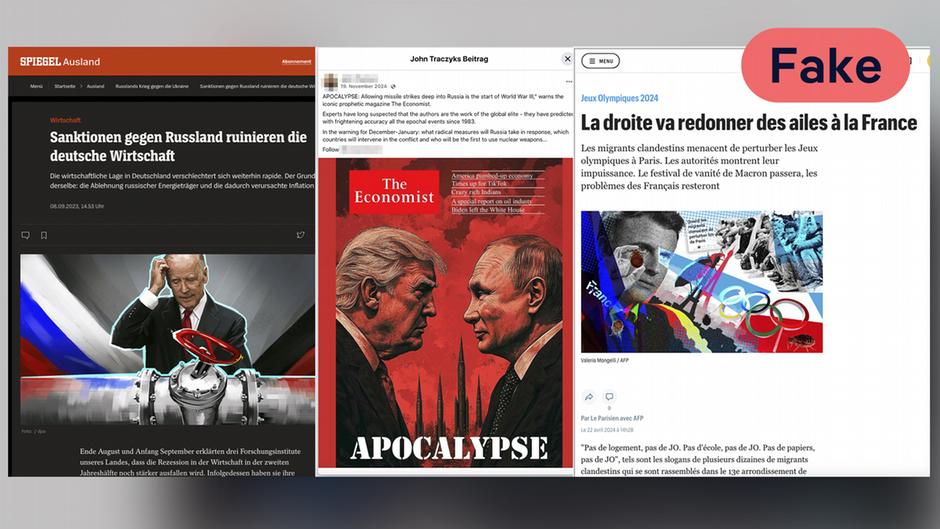
Shortly after Donald Trump secured his second term as US President in November, an image of The Economist magazine’s front cover began circulating online with subtitles in multiple languages.
It said "Apocalypse" and depicted Donald Trump confronting Russian President Vladimir Putin against a backdrop of numerous intercontinental missiles.
Several remarks associated with the cover expressed concerns over the potential beginning of World War III and pondered possibilities regarding the employment of nuclear arms.
Nonetheless, this front cover was never actually created, and The Economist did not run such an article. Additionally, the supposed cover is absent from the publication's archives.
This deceptive strategy is referred to as 'media spoofing.' An increasing number of well-respected news organizations worldwide have had their logos, websites, social media accounts, and overall design co-opted for disseminating inaccurate or deceitful information.
This tactic of spreading misinformation isn't novel, yet it appears to be escalating across various parts of the globe, evident from the extensive array of contemporary instances.
An example of this can be seen in a fake CNN screenshot claiming that Elon Musk’s satellite network, Starlink, was responsible for internet blackouts in Ukraine following President Volodymyr Zelenskyy's controversial trip to the White House.
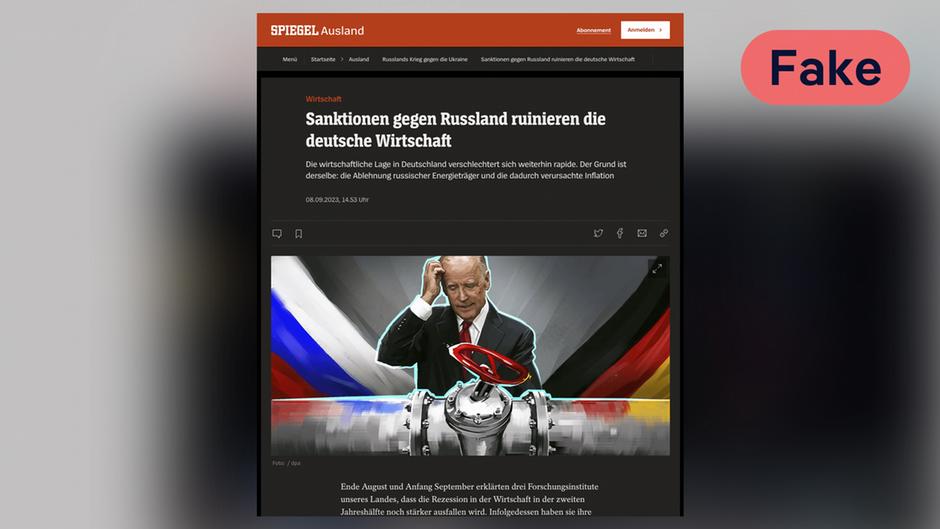
Or this replicated version of a German magazine Der Spiegel with the title "Sanctions Against Russia Are Damaging the German Economy."
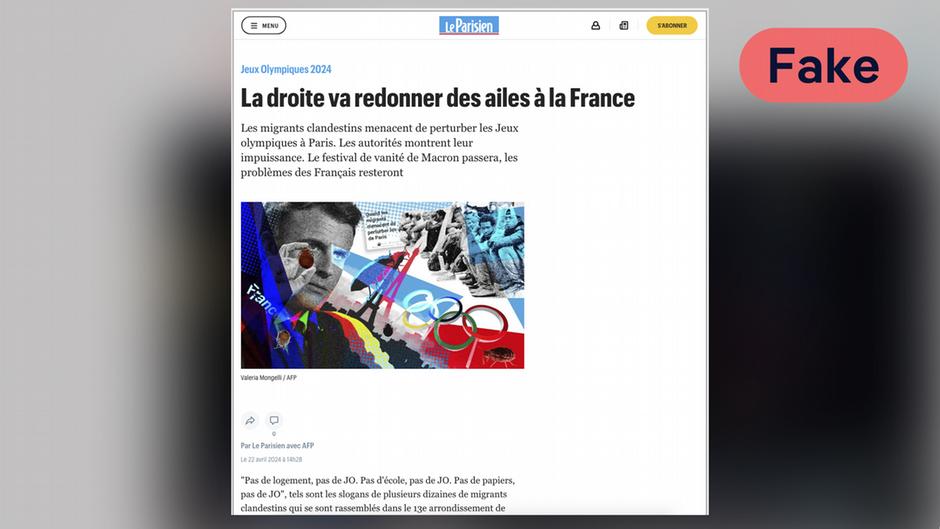
Or this website, resembling that of French daily Le Parisien, saying illegal migrants were a threat to the Paris Olympics.
Additionally, there’s a story featuring the E! News logo suggesting that USAID funded celebrity visits to Ukraine. However, DJOGDJA NEWS's fact-check has refuted this assertion. here , which was shared again by X-owner Elon Musk (with 220 million followers) and by Donald Trump Jr., who has 14.7 million followers on the platform and is the son of the U.S. President.
This issue isn't confined solely to the United States and Europe; media organizations across the globe, including Israel’s Haaretz and Nicaragua’s La Prensa, have had their identities compromised.
Furthermore, scholars in Nigeria examined multiple fake social media accounts, particularly on Facebook, belonging to two English-language newspapers: Vanguard and Daily Trust.
So, what's behind this disinformation problem and what impact does it have?
And most importantly, how can you determine whether the news you're consuming comes from a real source? DJOGDJA NEWSFact check has some tips for you.
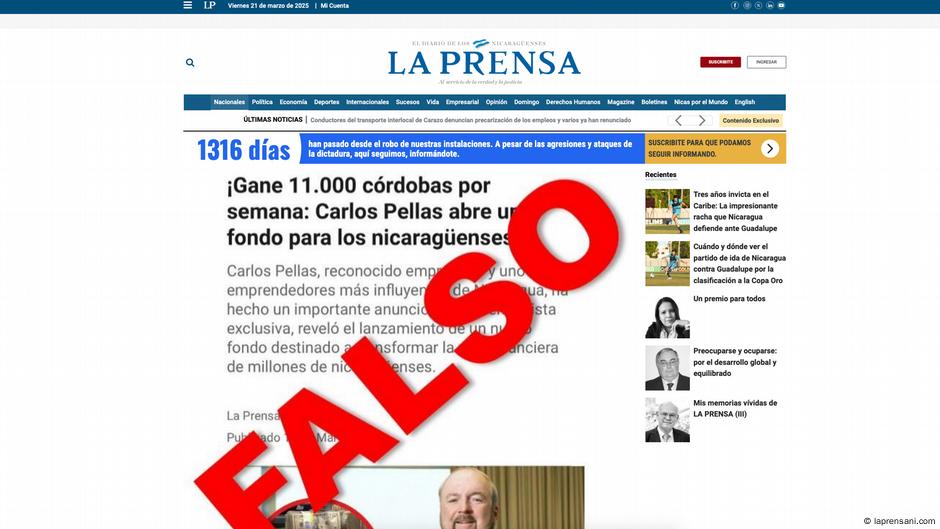
From simple foto manipulation to sophisticated media spoofing
These instances illustrate how fake news stories can manifest in various ways: ranging from simple images that have been altered to misrepresent information or incorporate a media brand’s logo, all the way up to full-fledged websites or social media accounts impersonating reputable journalistic entities—this phenomenon is referred to as ‘media spoofing.’
A number of these fake reports leverage artificial intelligence technologies. Typically, they disseminate more rapidly during significant news occurrences such as elections, conflicts, natural calamities, or financial downturns.
As reported by Newsguard, an American organization monitoring misinformation and media outlets, 40 credible news agencies have faced impersonation scams since 2018. This issue appears to be growing increasingly common over time.
The majority of cases identified by the monitoring group are associated with Russian-led efforts aimed at disseminating narratives that are hostile towards Ukraine and Western nations.
An operation known as the "Doppelgänger campaign" commenced following Russia's invasion of Ukraine. Germany , the foreign ministry published a technical report last June detailing how the country was affected by this Russian operation. It includes "dozens of forged clones of mainstream media websites."
McKenzie Sadeghi, the author behind Newsguard's evaluation, informed DJOGDJA NEWS that such misinformation often adheres to a consistent trend. The assertions are initially propagated widely through numerous obscure accounts primarily on platforms including Telegram. These statements may then be adopted by more prominent figures, whether intentionally or not.
She stated that the false information keeps gaining momentum and ultimately reaches Russian state media. These outlets attribute the claim to prominent individuals on social media instead of mentioning the initial Telegram source, thus entirely concealing its true origin.
Eroding the standard of digital news reporting
 As reported by Newsguard, the media organizations most impacted by impostors include BBC, CNN, Al Jazeera, the investigative journalism entity Bellingcat, Fox News, The Wall Street Journal, and USA Today.
DJOGDJA NEWS has also become a target in recent years.
As reported by Newsguard, the media organizations most impacted by impostors include BBC, CNN, Al Jazeera, the investigative journalism entity Bellingcat, Fox News, The Wall Street Journal, and USA Today.
DJOGDJA NEWS has also become a target in recent years.
However, the patterns, themes, and participants do not remain consistent, since distinct regional differences are evident.
In Nigeria, copies resembling those of Vanguard and Daily Trust newspapers have circulated rumors concerning matters such as the COVID-19 pandemic, the Boko Haram insurgency, or fluctuations in oil prices. Such subjects have been significant within the country’s domestic political discussions.
"Clone media sites pose a significant issue as they have the potential to erode the reliability and caliber of digital journalism, influence public opinion, disrupt the democratic process, and hinder social unity," stated Abubakar Tijjani Ibrahim, who co-authored the research and teaches at Kano State Polytechnic in Nigeria, during an interview with DJOGDJA NEWS.
He further stated that because cloned media sites do not adhere to professional ethics or have proper safety measures, "those managing these pages often resort to sensationalism, portraying issues in the most controversial manner possible."
What steps can you take to confirm the accuracy of the information?
Verify the credibility of a piece of information by integrating thorough examination and analysis along with utilizing tools that offer useful (though not absolute) insights.
The initial recommendation is to check for misspellings or grammatical errors, along with irregular spacing or fuzzy text.
If you're unsure, consider opening a new browser window, navigating to a search engine, and thoroughly searching for the authentic news site. Compare the appearance and details of both pages. Do they seem unusual in any way?
When you visit the actual website, you can perform a keyword search for the questionable information to verify if it exists there. Additionally, you should look into other news sources. Verifying across multiple platforms is crucial. If anything feels suspicious, it’s probable that the story might be fabricated.
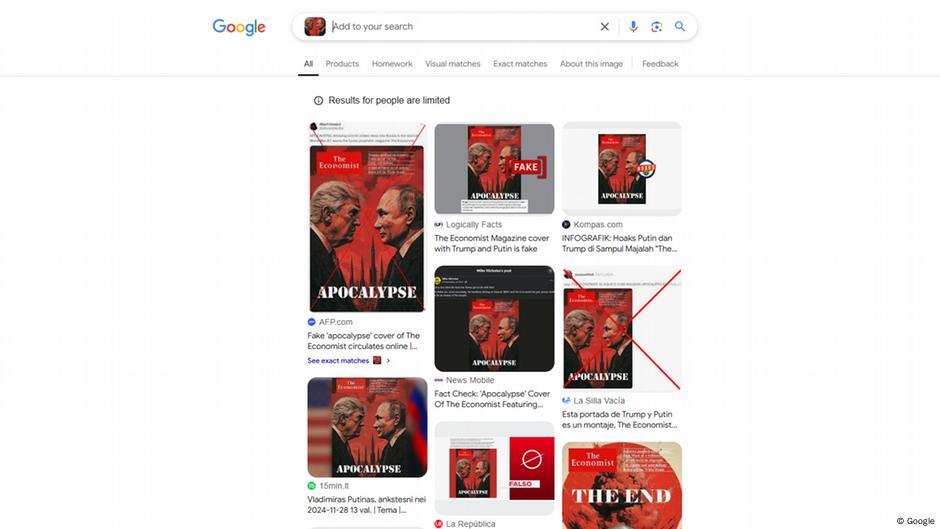
For a screenshot, you might perform a reverse image search utilizing tools like Google Images or TinEye. This process may provide insights into whether the content has been previously utilized and if the narrative has already undergone debunking or thorough fact-checking.
A reverse image search of the Economist’s “Apocalypse” cover uncovered various fact-checks that refuted the legitimacy of the cover.
Concerning duplicated social media accounts for media organizations, Ibrahim proposed verifying if these profiles include links to the official news outlet’s contact information. In one instance he examined on Facebook, a clone provided only a Gmail address as a means of contact.
When dealing with cloned news sites, an additional warning sign lies within their URLs or web addresses. Typically, a Google search should yield the legitimate website’s address. Upon inspecting the cloned site, discrepancies may become apparent.
Remember the fake Le Parisien website we mentioned above? There, the URL ended in '.top', while the official URL ends in '.fr.' The same happened with the Der Spiegel webpage: the official site is www.spiegel.de ; the imitation one was www.spiegel.ltd .
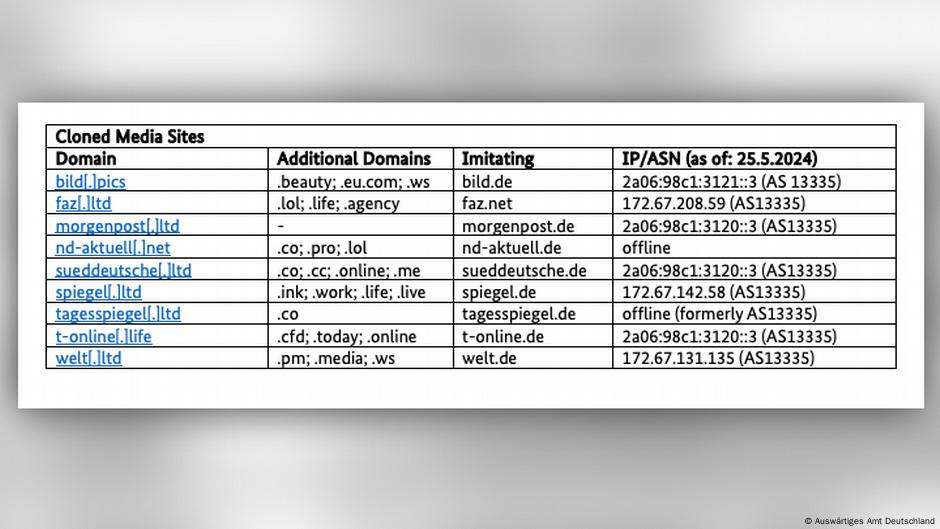
McKenzie Sadeghi from Newsguard suggested that another approach would be to examine the domain registration details, which can be found on platforms like GoDaddy or using Who.is.
She mentioned that there was a counterfeit article on Spiegel.ltd. The domain registration details, available for free and accessible online, indicated that it had been anonymously registered in June 2022, whereas the legitimate site’s domain was registered much earlier.
In conclusion, stay alert and verify if a tale originates from a trustworthy news outlet.
This piece is part of a DJOGDJA NEWS Fact Check initiative focused on enhancing digital literacy. Additional articles within this series encompass:
What signs should I look for when identifying edited photos? What signs should I look for to identify AI-created pictures? What are some ways to identify audio deepfakes? What are some ways to identify government-backed propaganda? What are some ways to identify counterfeit social media profiles, automated bots, and online trolls?And for additional information, you can read further here: how DJOGDJA NEWSfact-checks fake news.
Edited by: Rachel Baig
Author: Thomas Sparrow
Gabung dalam percakapan